
In a rental situation, replacing burnt-out light bulbs is part of the regular maintenance that falls to the tenant. Confusion arises at the time of departure: should new bulbs be purchased to leave in each socket, or can the tenant take the ones they paid for? The answer depends less on a specific legal text than on what is stated in the lease and the move-in inspection report.
Light bulb, socket, and fixture: three distinct legal statuses
The distinction between these three elements determines everything else. A fixture attached to the wall or ceiling (sconce, ceiling light, recessed spot) is part of the rental property. It must remain in place upon departure, unless there is written agreement from the landlord.
The socket, connected to the electrical circuit, also belongs to the rental property. It is not removable.
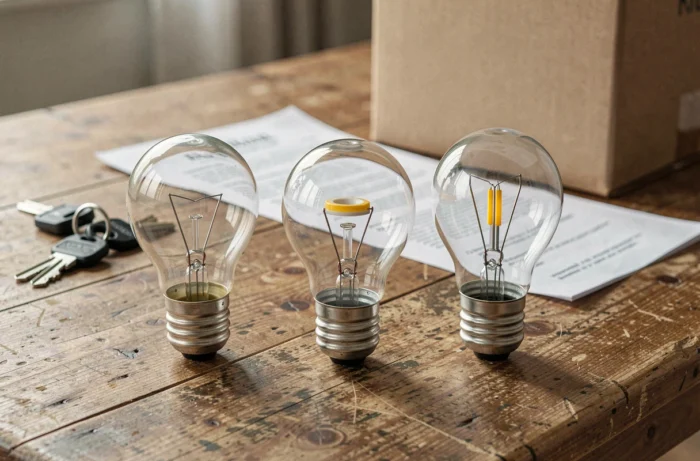
The light bulb, on the other hand, is a consumable item. Several legal sources classify it in the same category as a faucet washer or a range hood filter: a wear item that the tenant replaces during the rental period, but which does not have the status of permanent equipment. The question of leaving bulbs when moving out of a rental thus hinges on this boundary between consumable and equipment.
In practical terms, if the property was rented with functional bulbs noted in the move-in inspection report, the tenant must return functional bulbs. If nothing is mentioned, there is more leeway.
What the lease and the 1987 decree actually impose on the tenant
Decree No. 87-712 of August 26, 1987 lists the repairs that are the tenant’s responsibility. It mentions the regular maintenance of the property’s equipment, which includes the replacement of bulbs during the lease term. The text does not say anything about the obligation to leave new bulbs upon departure.
The lease may go further. Some contracts include a clause that requires the property to be returned with all bulbs in working order. This stipulation, if it exists, takes precedence over general usage. Checking this clause before the move-out inspection avoids any surprises.
In the absence of a specific clause, there is no legal obligation to purchase new bulbs for departure. The tenant must return the property in a condition consistent with the move-in inspection report, normal wear and tear deducted. A bulb that burned out after several years of use falls under wear, not degradation.
Move-in and move-out inspections: the real lever against disputes
The dispute does not arise from the bulb itself, but from the discrepancy between the move-in and move-out inspection reports. If the move-in report states “all bulbs functional” and several sockets are empty at departure, the landlord may withhold an amount from the security deposit to restore the property.
What to check and document
- Review the move-in inspection report room by room to identify each light point mentioned, including its type of bulb if specified
- Photograph each fixture lit on the day of departure, with the date visible on the photo (or an automatic timestamp), to prove that the lighting works
- Check the lease for any specific clause regarding the return of bulbs or lighting equipment
- Keep receipts for bulbs replaced during the rental, especially for expensive models (specific LEDs, decorative bulbs)
These documents serve as evidence in case of disagreement. The move-out inspection compares the existing condition to that at move-in: without mention of bulbs at move-in, the landlord will have difficulty justifying a deduction.
The trap of an incomplete move-in inspection
An incomplete move-in inspection that does not mention the bulbs works in favor of the tenant. The principle is simple: what is not noted at move-in is presumed to be in good condition. However, if the property is returned with empty sockets while the move-in report mentioned bulbs, the landlord has a strong argument.
The real risk focuses on properties returned with one or more rooms without any functional lighting. The landlord may then classify the situation as a failure to perform regular maintenance, even without an explicit clause in the lease.

Expensive LED bulbs: take them or leave them?
A tenant who has replaced basic bulbs with high-performance LEDs faces an economic choice. These bulbs, sometimes purchased for several euros each, represent a personal investment.
The rule remains consistent with the status of consumables. If the tenant has replaced an incandescent bulb with an LED, they can take the LED and replace it with a bulb equivalent to the original, provided that the socket remains equipped with a functional bulb (if the move-in inspection noted it).
Replacing each affected socket with a low-cost bulb costs a few euros and eliminates any reason for a deduction from the security deposit. Better to spend two euros on a bulb than to face a dispute over the deposit.
Sale of the property: a different logic from renting
In the case of a sale, the situation changes. Fixed fixtures (sconces, ceiling lights, recessed spots) are considered real property by destination. They remain in the property unless otherwise stated in the sales agreement. The bulbs present follow the fixture.
A seller who unscrews their fixtures without having indicated this risks a challenge from the buyer. For rentals, this logic does not apply to bulbs alone, which retain their status as consumables.
The question of bulbs at the end of a rental is almost always resolved in advance. A tenant who reviews their lease, compares it with the move-in inspection report, and photographs each light point on the day of departure protects themselves from an unjustified deduction. The cost of a few replacement bulbs remains trivial compared to that of a dispute over the security deposit.