
Between closing windows to cut off oxygen and opening them to evacuate smoke, the answer depends on a rarely articulated parameter: the location of the fire in relation to the occupants. An interior fire and a vegetation fire approaching a house require very different actions regarding openings. Comparing these two scenarios helps to understand why a single guideline is not sufficient.
Ventilation and combustion: the physical mechanism behind the action
A domestic fire needs three elements to sustain itself: fuel, heat, and oxygen. Opening a window in the room where the fire is burning directly feeds this third factor. The natural draft created by the influx of air accelerates combustion and can turn a localized fire into a widespread blaze.
Conversely, closing an interior door keeps smoke in the original room and reduces the supply of fresh air to the fire. This slowing down occurs even with an ordinary door, without fire resistance classification. Pressure and heat build up behind the door, but adjacent rooms remain breathable for longer.
The question of whether to open windows in case of fire finds its first element of response here: as long as the fire is inside the dwelling, each additional opening worsens the situation for occupants who are not in the room on fire.
Interior fire or exterior fire: comparative table of guidelines on openings
Recent official guidelines clearly distinguish between two situations. The table below summarizes the recommended actions based on the origin of the fire.
| Scenario | Interior doors | Windows | Shutters and vents | Locking |
|---|---|---|---|---|
| Fire inside the dwelling | Close behind while evacuating | Close those in the room on fire | No specific guideline | Do not lock |
| Exterior fire (forest, vegetation) | Close to confine | Close to block smoke and embers | Close shutters, turn off ventilation and air conditioning | Do not lock |
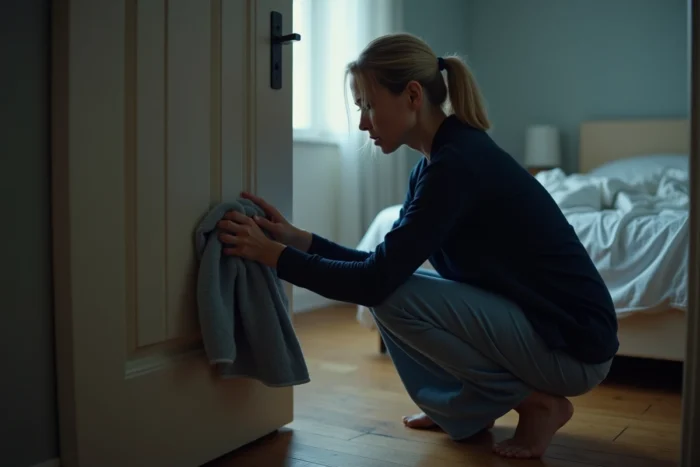
| Person trapped in a room | Seal with wet cloth | Keep closed or slightly ajar to signal presence | Not applicable | Do not lock |
A common point runs through all three cases: close without ever locking. Operational guides emphasize this nuance to avoid hindering rescue access or trapping people left inside.
Toxic smoke and closed door: the factor that kills before the flames
The majority of deaths in domestic fires are related to inhalation of smoke, not direct burns. An open interior door allows toxic gases to invade hallways and bedrooms within minutes. Sleeping occupants then have no time to react.
The door matters more than the window in the survival of occupants. Closing the door of a bedroom before sleeping is a simple preventive action whose effect on survival time is significant: the concentration of carbon monoxide remains low much longer in a room isolated from the fire.
On the other hand, opening a window in a room distant from the fire does not pose the same danger as opening one in the room on fire. If you are confined in a bedroom with the door closed and sealed, the window can serve two specific purposes:
- Signal your presence to rescuers by shouting, waving a cloth, or calling from this visible point
- Breathe momentarily if smoke begins to seep under the door despite the sealing
- Allow evacuation from the outside if the dwelling is on the ground floor or first floor
The window becomes a communication point, not a ventilation system. Opening it wide to “air out” a smoke-filled room actually sucks in more toxic gases from the burning areas due to the draft effect.
Vegetation fire close to the house: close and confine
When a vegetation fire approaches, the logic partially reverses. The fire is outside, and the goal is no longer to limit the oxygen available to the fire but to prevent smoke and embers from entering the dwelling.
The guidelines in this case are more comprehensive than for an interior fire:
- Close all windows, doors, and shutters to create a physical barrier against embers and radiant heat
- Turn off mechanical ventilation (VMC) and air conditioning, which draw in outside air laden with particles
- Seal visible air intakes with wet cloths
- Do not lock the gate to allow free access for firefighters
The interaction between windows and ventilation systems is an angle often absent from public guides. A functioning VMC can negate the effect of a closed window by injecting polluted air into every room of the dwelling.
Risk of thermal explosion: why a breaking window changes everything
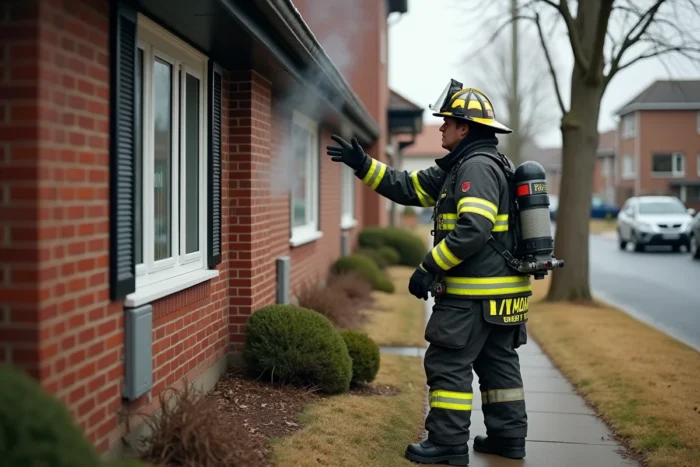
A closed window in the room on fire is not a permanent protection. Under the effect of heat, the glass eventually gives way. The sudden influx of oxygen then triggers a phenomenon that firefighters know as backdraft: a violent thermal explosion that can project flames well beyond the original room.
This risk explains why firefighters systematically assess the state of windows before intervening. A blackened and intact window signals a fire confined under pressure. Teams adjust their approach accordingly, and anyone near such a window is at real danger.
For occupants, the guideline remains the same: do not open the window of the room on fire, leave that room while closing the door behind you, and move away from the axis of the glazed openings from the outside.
The action to remember can be summarized in a sequence: close, do not lock, evacuate or confine depending on the possibility of exiting. The window is only opened to signal your presence, never to ventilate a space filled with flames or smoke. This distinction between communication and ventilation is the dividing line between a protective reflex and an action that worsens the situation.