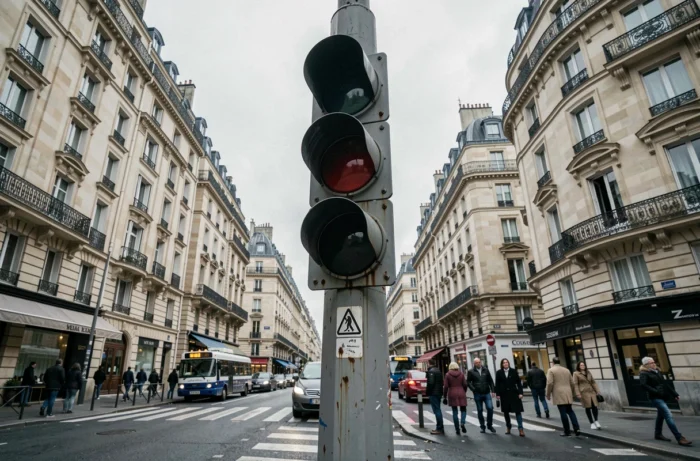
A crossroads, three traffic lights out, and no one knows who goes first. This situation is common, often poorly managed, yet the Highway Code provides specific rules to address it. Understanding these rules and knowing whom to report the malfunction to can help avoid both accidents and unjust fines.
Responsibility of the road manager: who repairs a malfunctioning traffic light
You might think that the town hall manages all the traffic lights in your city. In reality, the competent manager depends on the type of road. A departmental road falls under the department. A municipal road is managed by the municipality or intermunicipality. A national road is under the State.
This distinction changes everything when it comes to reporting a malfunction. Reporting to the correct manager speeds up the repair. Contacting the town hall for a light located on a departmental road adds an unnecessary intermediary, as the town hall will have to forward the issue to the departmental council.
Several local authorities have set up platforms dedicated to reporting signaling malfunctions. Some offer an online form with geolocation, photo, and tracking by ticket number. Montpellier, for example, has a portal for reporting issues on public roads. Other municipalities entrust maintenance to a specialized provider and provide a toll-free number to contact them directly.
When you spot the malfunctioning traffic light, the steps to follow vary by locality, but the reflex remains the same: identify the manager, provide the exact address of the intersection, and describe the type of malfunction (light out, permanently flashing orange, blocked sequence).

Light out or flashing orange: which priority rule to apply
A traffic light can malfunction in two visible ways. Either all three colors are off, or the orange light is continuously flashing. In both cases, the light no longer fulfills its regulatory function.
The default rule becomes priority to the right. This is the basic principle of the French Highway Code: in the absence of contrary signage, the vehicle coming from the right goes first. Many drivers forget this because they usually drive on priority roads.
Presence of a complementary traffic sign
Some intersections equipped with lights also have a fixed sign (yield, stop, priority). This sign takes over when the light is not functioning. A stop sign remains valid even if the light above is off.
Before entering the intersection, look up beyond the light. Look for a sign on the same pole or on a nearby post. If you spot one, follow its instructions. If no sign is visible, apply the priority to the right, even if you are on a normally priority road.
Adjusting speed and behavior
The absence of a functioning light creates uncertainty for all users, including pedestrians. Reducing speed as you approach the intersection is not a vague recommendation; it is a duty of caution enshrined in the Highway Code.
- Significantly slow down before the intersection and scan all converging lanes
- Check for pedestrians who may also be disoriented by the malfunction
- Never accelerate to “get through quickly” hoping others will brake
- In case of doubt about priority, stop as you would at a stop sign
Reporting a malfunctioning light: concrete steps in France
A quick report protects other users and can also legally protect you. If you receive a fine related to this intersection, having reported the malfunction constitutes solid evidence.
Take a photo of the malfunctioning light with a visible timestamp. Most smartphones automatically record the date, time, and GPS location in the photo’s metadata. This reflex takes a few seconds and can make a difference in a contestation case.
Available reporting channels
- The website or reporting app of your municipality or intermunicipality (form with photo and geolocation)
- The phone number of the road or traffic service of the competent authority
- In case of immediate danger (light stuck on green in all directions, ongoing accident), call the municipal police or gendarmerie to secure the area
A malfunctioning light at an accident-prone intersection justifies a call to law enforcement, not just an administrative report. Officers can intervene to manually regulate traffic while waiting for repairs.
Challenging a fine for running a red light at a malfunctioning light
You have received a notice of contravention for running a red light, but the light was malfunctioning at the time of the incident. Contestation is possible, but it requires a solid case.
The fine for disregarding a red light results in a financial penalty and a deduction of points from your license. Challenging this infraction goes through the ANTIA platform (National Agency for Automated Processing of Offenses) or by registered mail addressed to the public prosecutor.
Evidence to gather for the contestation
Simply saying “the light was not working” is not enough. You must provide concrete elements:
- The photo or video of the malfunctioning light taken on the same day, with a timestamp
- The receipt of the malfunction report to the authority (ticket number, confirmation email)
- Testimonials from other users present at the same time
- Any element proving a maintenance failure or a known malfunction by the manager
Building this case as soon as the malfunction is observed is the best protection. Waiting to receive the fine to look for evidence significantly reduces your chances of success, as digital traces and available witnesses fade quickly.
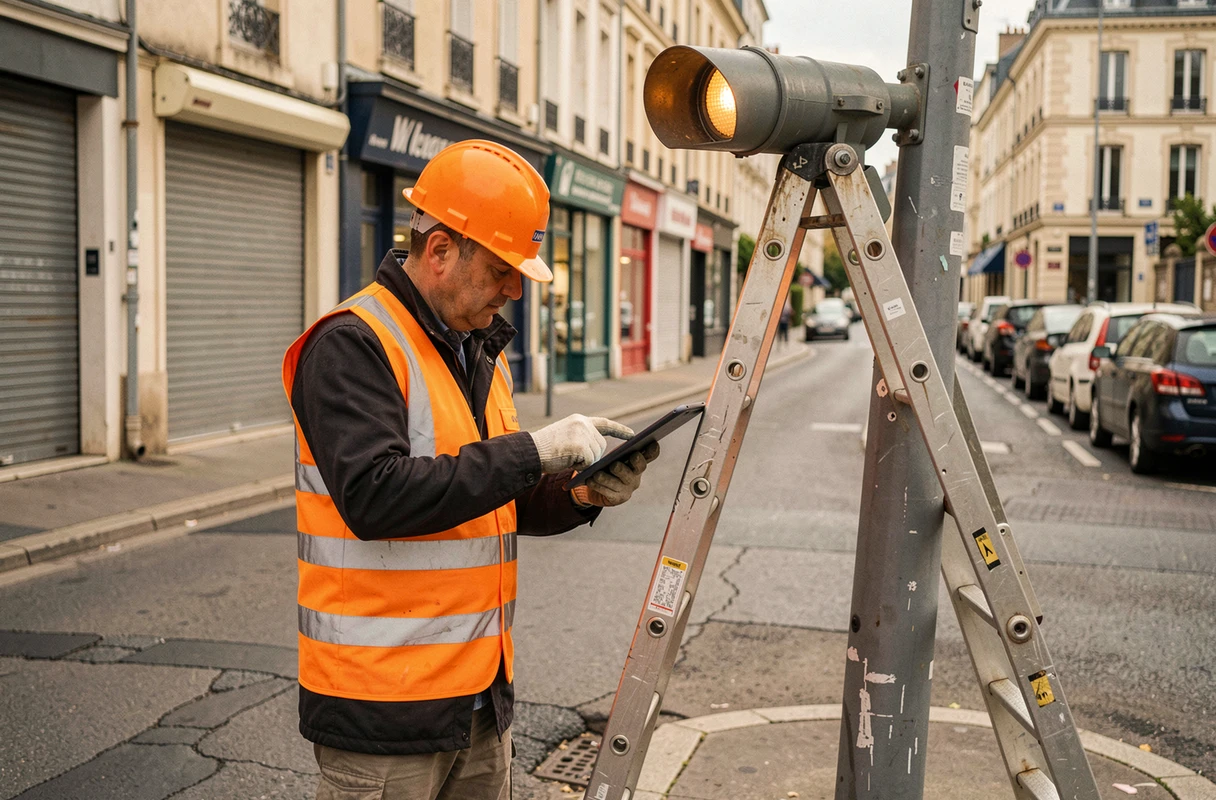
In the face of a malfunctioning traffic light, priority to the right becomes the rule unless indicated otherwise, reporting to the correct manager speeds up repairs, and a timestamped photo taken at the moment remains your best ally if a fine arrives in your mailbox.