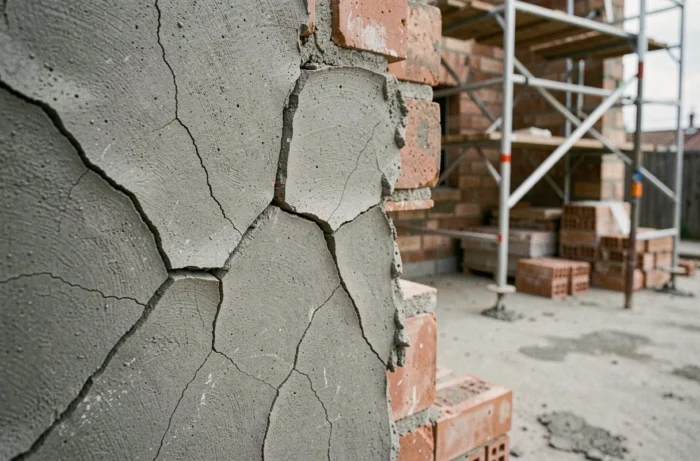
A new mortar that cracks within hours or days after application almost always indicates a formulation defect or application conditions issue. Identifying the exact cause allows for intervention on the correct parameter, without unnecessarily redoing the entire work. Cracks in fresh mortar are classified into two distinct families: plastic cracks (before complete hardening) and drying shrinkage cracks (after hardening), each resulting from different mechanisms.
Grain size of sand and shrinkage of new mortar
Sand that is too fine is the most underestimated factor for cracking on site. The lower the fineness modulus, the greater the specific surface area of the grains, which requires more mixing water to achieve proper workability. This excess water then evaporates and amplifies shrinkage.
We recommend sand with a well-graded particle size distribution, with a sufficient proportion of medium grains. Washed river sand, with few clay fines, limits both plastic shrinkage and delayed shrinkage. Sand that is too fine multiplies shrinkage and thus micro-cracking.
The content of clay fines (passing through a 63 µm sieve) plays an aggravating role: these particles increase the water demand without contributing to mechanical strength. When a mortar is crumbling according to La Maison Durable, the grain size of the sand is the first parameter to check before questioning the cement dosage.
The addition of polypropylene fibers in the screed or plaster mortar significantly reduces plastic shrinkage cracks. These short fibers (about 12 mm) create a three-dimensional network that takes up tensile stresses at the moment when the cement matrix has not yet gained its own strength.
Application thickness and uneven drying of mortar
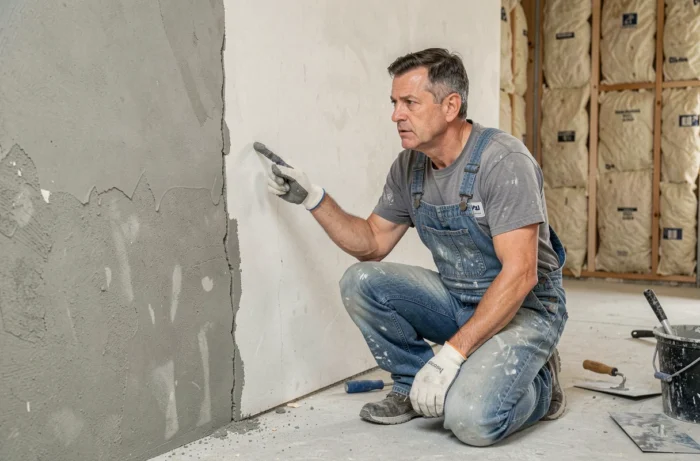
An excessively thick layer is itself a factor for cracking, regardless of the quality of the mix. The core of the layer retains its moisture much longer than the surface, creating a differential shrinkage gradient. The outer skin contracts while the inside remains plastic: cracks appear on the surface, sometimes within a few hours.
For a facade plaster, we observe that adhering to a maximum thickness per pass (generally the value recommended by the manufacturer for the product used) eliminates most plastic shrinkage cracks. When the total required thickness exceeds this limit, it should be split into two passes with an intermediate setting time.
Weather conditions at the time of application
Ambient temperature, wind, and direct sunlight accelerate surface evaporation. Mortar applied in full sun on dry, windy days loses its surface water before the setting has begun to harden the matrix. The resulting plastic cracks are wide, short, and typically appear within the first hour.
- Support and air temperature above the threshold recommended by the technical data sheet: thoroughly wet the support and renew the wetting if necessary.
- Strong wind: protect the area with a covering that limits evaporation without preventing air circulation.
- Direct sunlight: delay application on a facade exposed to the time slot when it goes into the shade, or mist the surface after application.
These precautions fall under the curing of fresh mortar, a point often overlooked even though it directly affects the final strength and absence of cracks.
Support-mortar compatibility and substrate preparation
A rigid mortar (highly cemented) applied to an old, porous, or already micro-cracked substrate will take on all the movement constraints of the substrate. The substrate absorbs water from the mortar unevenly, locally accelerating shrinkage and causing detachment or map-like cracking.
The choice of binder must match the rigidity of the substrate. On a wall made of old stone or uncoated concrete blocks, a bastard mortar (cement-lime) offers sufficient flexibility to accommodate micro-movements without cracking. A pure cement mortar on this type of substrate is a classic prescription error.
Wet the substrate before application
Simply moistening is not enough. A concrete block or brick substrate absorbs water very quickly: it must be saturated, then wait for the surface water film to disappear before applying the mortar. An overly dry substrate sucks up the mixing water, shortens the open time, and causes abrupt shrinkage. A dripping substrate prevents adhesion.
We systematically conduct an absorption test before the project: a few splashes of water on the wall allow us to judge the suction speed and adjust the wetting protocol.
Curing time of new mortar before covering
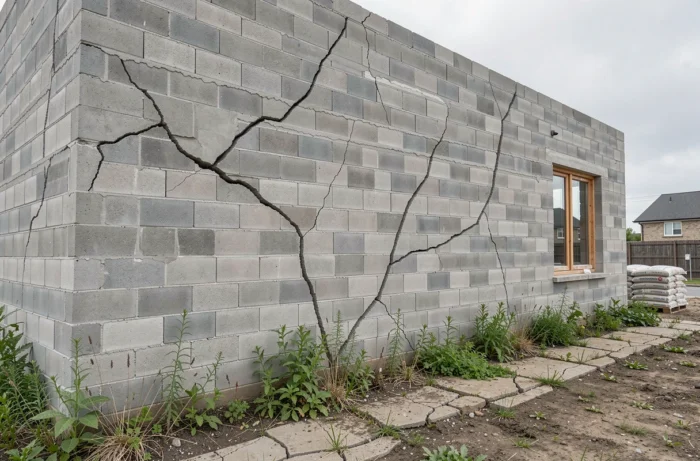
Covering or loading mortar too early is a frequent source of late cracking. The mortar continues to shrink for several days after initial setting. If tiles, a finishing coat, or mechanical load is applied before this shrinkage is stabilized, internal stresses are released in the form of cracks, sometimes only visible weeks later.
Respecting the curing time before any covering is the simplest and most often ignored preventive measure on fast-paced sites. This time varies depending on the nature of the mortar, the thickness applied, and ambient conditions. Shortening this time to meet a schedule generates rework that costs more than the initial wait.
- Screed before tile installation: wait for the main shrinkage to occur, maintaining regular moisture during curing.
- Base coat before finishing coat: allow the base coat to gain its mechanical strength; applying the finish on a still active substrate in shrinkage guarantees cracking.
- Sealing mortar before loading: do not mechanically stress the work until the compressive strength has reached a sufficient level.
The initial water dosage also influences the necessary curing duration. A mortar that is too liquid at the start will take longer to expel its excess water and will remain vulnerable to drying shrinkage cracks for an extended period.
Preventing cracks in new mortar relies on four interrelated parameters: grain size of the sand, thickness per pass, compatibility with the substrate, and effective curing duration. Correcting just one of these factors without checking the others guarantees nothing. On a new site, we check these four points before each application phase, which drastically reduces rework.