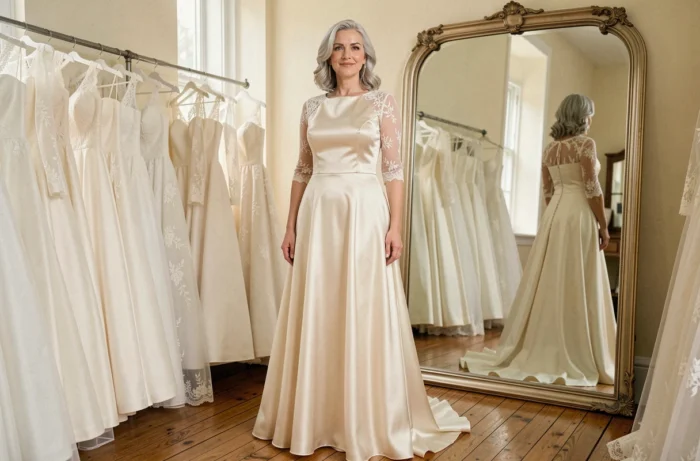
A wedding dress chosen after 60 years meets specific technical criteria: a cut suitable for a mature silhouette, materials that provide support without constraint, and practicality throughout the duration of the celebration. The market today offers models designed for these requirements, provided you know where to look and what to prioritize.
Practical autonomy of the dress: the criterion that fittings do not test
Style advice occupies the majority of available guides. One aspect often overlooked is: the dress must remain easy to manage alone for several hours.
Accessing the restroom in a long train dress, fastening a row of buttons at the back without assistance, putting on the outfit on the morning of the wedding without contortion: these actions determine real comfort. A zip closure on the side or front, for example, radically changes the experience compared to a back lacing.
Two cuts stand out in this regard. The wrap dress slips on without going over the head and ties at the waist, simplifying each trip to the restroom. The two-piece set (bodice and skirt or fluid pants) offers the same freedom, with an added advantage: each piece can be worn separately after the wedding.
During the fitting, testing these concrete actions (sitting, standing up, raising arms, walking up stairs) provides more reliable information than the reflection in the mirror. Choosing a wedding dress after 60 years becomes more relevant when ease of movement is treated as a selection filter, not as a bonus.
Fabrics and fabric hold: what works on a mature silhouette
The choice of fabric directly influences how the dress falls, breathes, and ages throughout the day. Not all materials behave the same way on a 60-year-old body.
Crape and stretch satin: fluidity and support
Crape remains the most cited fabric by professionals for mature brides. Its matte texture absorbs light instead of reflecting it, avoiding the unflattering “shine” effect under flashes. Crape hugs the silhouette without compressing it, and it hardly wrinkles, a plus for a ten-hour day or more.
Stretch satin combines the shine of classic satin with elasticity that follows movements. It suits sheath or column cuts, provided the lining is of good quality. A cheap synthetic lining causes excessive sweating, especially during summer weddings.
Structured lace and chiffon: two distinct uses
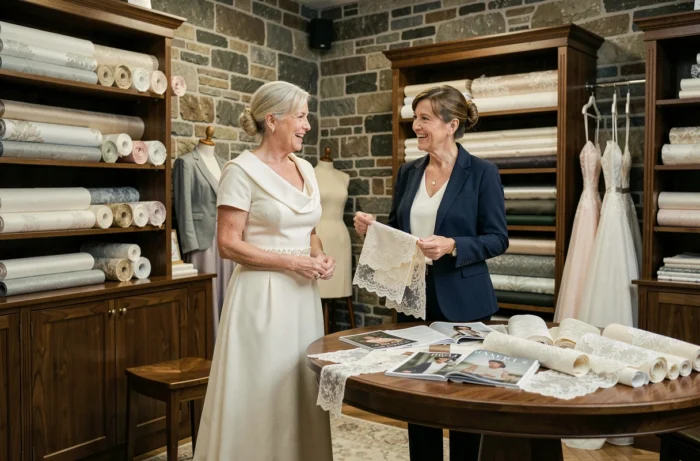
Lace works better in layering (on sleeves, neckline, back) than as the main fabric. A dress entirely made of fine lace often lacks structure at the bust and waist. Favoring lace with geometric or graphic patterns rather than heavily floral patterns brings modernity.
Chiffon, light and airy, serves as an ally for stoles or removable over-skirts. Alone, it lacks hold and requires an opaque underskirt to avoid transparency.
Modular outfit for a two-part wedding
Celebrations that stretch over two days (ceremony followed by brunch or meal the next day) are becoming increasingly common. Planning a single fixed outfit for the entire event exposes one to discomfort or a mismatch in attire.
A pragmatic approach is to think of the outfit as a system with detachable elements:
- A short crape jacket or structured stole to cover the shoulders for the ceremony, then removed for the dancing dinner
- A long skirt for the town hall or church, replaced by a midi version or palazzo pants for the continuation
- Closed shoes with a small block heel for the ceremony, and ballet flats or flat sandals tucked into a bag for the evening
Modulating the outfit avoids buying two complete dresses while adapting to the rhythm of the celebration. This reasoning also touches on the economic aspect: a transformable set generally costs less than two distinct outfits.
Colors and necklines: balancing personal taste and visual flattery
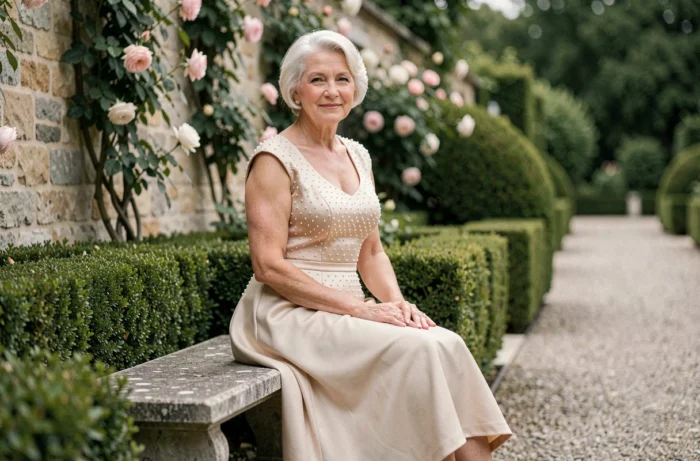
All-white is not mandatory, especially after 60. Powdery shades (champagne, rosy ivory, greige) soften the contrast with the skin and give a natural glow to the face. Warm ivory suits lighter skin tones better than optical white, which tends to accentuate features under artificial lighting.
For bold colors, navy blue, deep burgundy, or sage green work well for civil ceremony dresses. The choice depends on the setting: a stone town hall calls for more muted shades than a garden in full sunlight.
Necklines that enhance without exposing
The bateau neckline remains the most universally flattering neckline after 60. It visually broadens the shoulders, structures the upper bust, and conceals the base of the neck without creating an upward effect.
A moderate V-neck elongates the silhouette and suits women with generous busts. However, a plunging V requires a technical bra that can create visible lines under a fluid fabric.
- Bateau: narrow to medium shoulders, small to standard bust
- Moderate V: generous bust, short neck
- Illusion neckline (nude tulle with embroidery): arms that one wishes to veil without the long sleeve effect
- V-back or partial backless: an alternative to the front neckline for those who prefer to cover the front
Purchase, rental, or second-hand: a choice that goes beyond aesthetics
Advice articles almost always steer towards new purchases. After 60, the question of what happens to the dress after the wedding deserves to be asked in advance.
Renting allows access to high-end models at a fraction of the price. It is particularly suitable when the dress will only be worn once and storage is an issue.
Second-hand offers a double advantage: reduced budget and the possibility of having the model tailored to fit with the savings made. Having a second-hand dress altered often costs less than a new entry-level model.
Buying new is justified when the dress is designed to be transformed (shortened, re-dyed) and worn for future occasions. A new two-piece set in a noble fabric retains its relevance well beyond the wedding day.
The final choice depends on a personal balancing act between budget, future use, and symbolic attachment to the garment. No option is superior to the others, but asking the question before the fitting avoids regrets later.