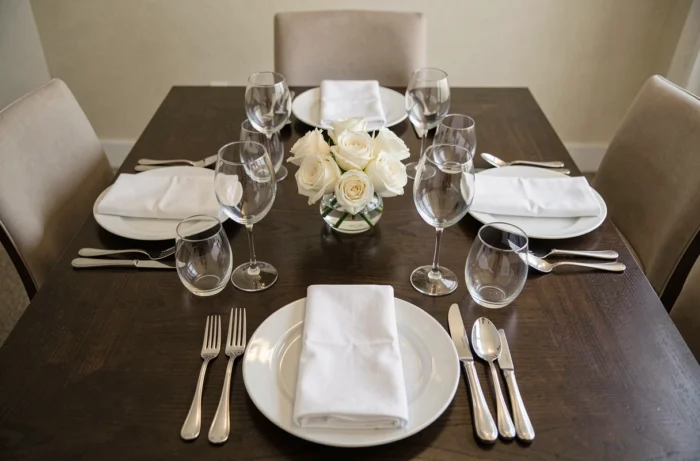
Setting a table for dinner involves solving a practical problem before any aesthetic considerations: where to place each glass so that guests can drink without hesitation, without spilling, and without searching for whose water glass it is. The rules of French service have long codified this logic, but their application varies depending on the number of wines served, the size of the table, and the style you wish to give to the evening.
Height of Glasses and Line of Sight Between Guests
Most table-setting guides focus on the horizontal arrangement of glasses. Few address a parameter that can change the atmosphere of a meal: the height of the glassware in relation to sight lines.
Anglo-Saxon table stylists recommend limiting the height of decorative glasses and centerpieces to about 30 cm, or raising them above 60 cm to clear the view between people sitting face to face. This guideline, notably articulated by Loui Burke in July 2026, directly applies to the choice of glasses: a very tall champagne flute or an oversized balloon glass can create an unintentional glass wall between guests.
When selecting your glassware, think first about conversation. A standard-sized water glass, a medium-sized red wine glass, and a not-too-tall flute are sufficient to maintain an unobstructed field of vision. Mastering the placement of glasses on the table also involves this attention to verticality, not just alignment on the tablecloth.
Order of Glasses in French Style: Diagonal or Linear Arrangement
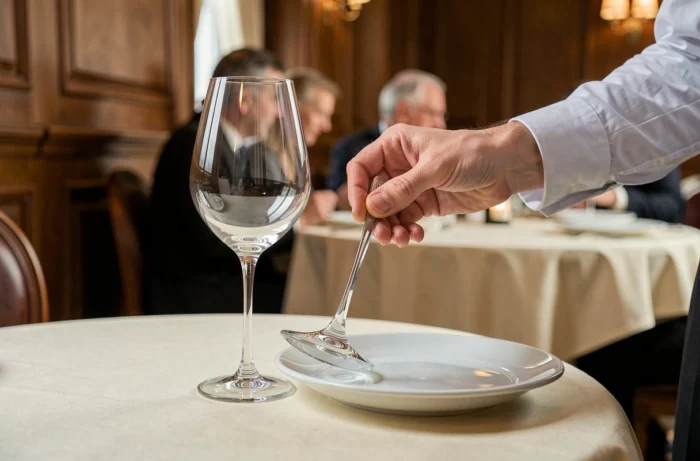
French service places the glasses at the top right of the plate, aligned along a diagonal that descends toward the right of the guest. The water glass, the largest, is positioned at the far left of this line (closest to the plate). Next comes the red wine glass, followed by the smaller white wine glass.
If you serve champagne for dessert or during an extended aperitif, the flute is placed slightly behind the other glasses, forming a triangle. The order follows decreasing size from left to right, allowing the guest to naturally grab the correct glass without crossing their arm in front of another.
Spacing Between Glasses
A regular gap between each glass foot prevents collisions when setting down a glass after drinking. Restaurant professionals work with enough spacing to slide two fingers between each glass. If too close, the glasses clink with the slightest movement. If too far apart, they encroach on the neighbor’s space.
Adjusting the Number of Glasses to the Menu
Three glasses constitute the most common setup for a dinner: water, red wine, white wine. For a meal where you serve only one wine, two glasses are sufficient and lighten the table. Multiplying glasses beyond four per guest clutters the surface and complicates service, except in a gastronomic setting with detailed food-wine pairings.
- One wine served: water glass and wine glass, positioned side by side with a slight offset
- Two wines (red and white): three glasses in a diagonal, water on the left, red in the center, white on the right
- Champagne in addition: flute positioned behind the water glass, forming a triangle with the two wine glasses
- Informal dinner without wine: a single water glass, centered above the knife
Mismatched Glasses and the Mix and Match Trend in 2026
Formal rules assume identical glasses for all guests. However, the decor trend of 2025-2026 embraces the mixing of thrifted, vintage, or differently colored glasses. Biba Magazine describes this approach as a “friendly revolution” where coherence relies on color and material harmonies, not on uniformity of shapes.
This aesthetic choice does not exempt one from respecting the functional logic of placement. Even with mismatched glasses, the water glass remains the largest and closest to the plate. The wine glass, whether a colorful tumbler or a retro short-stemmed glass, is placed to its right.
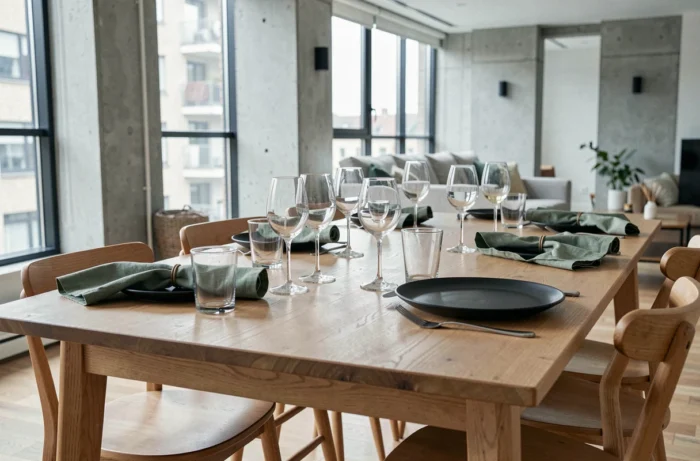
The advantage of mismatched glasses also lies in a practical benefit: each guest can immediately identify their glass by its unique shape or color. For large tables where cutlery is close together, this is an effective visual marker.
Common Mistakes in Glass Placement
Some mistakes consistently recur and are noticeable at first glance.
- Placing the water glass to the right of the wine glass: the opposite of the French rule, this forces the guest to cross their hand over the wine to grab the water
- Aligning glasses parallel to the edge of the table instead of following the diagonal: this “English” arrangement exists, but mixing the two systems on the same table creates inconsistency
- Placing glasses too far forward, above the plate: they obstruct the serving of dishes and risk being knocked over when clearing
The foot of the water glass aligns with the tip of the knife, providing a simple reference for positioning the entire line of glasses. If this first glass is well placed, the others naturally find their position diagonally to the right.
The Case of the Champagne Flute
The flute poses a specific problem: its height and narrow foot make it unstable. Placing it behind the other glasses protects it from abrupt movements. Some choose to place it only at the time of serving champagne, freeing up space during the meal.
The placement of glasses during a dinner reflects a balance between convention, practicality, and personal style. The French rules offer a reliable framework, but the most successful table is one where each guest finds their glass without thinking about it. Whether you opt for a classic diagonal setting or a mismatched composition, the logic remains the same: from the largest to the smallest, from the most frequently used to the most occasional.