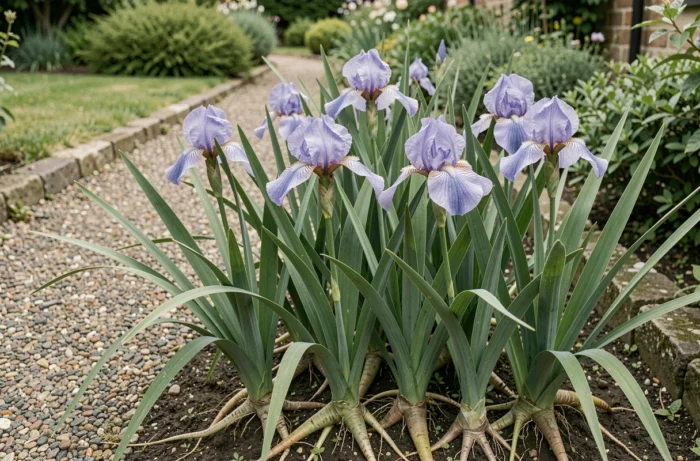
The walking iris produces flowers that resemble those of a garden iris, but on an indoor plant that has the appearance of a tropical grass. Its name comes from its unique way of spreading: after flowering, a seedling forms at the end of the flower stalk, which arches towards the ground and roots a little further away. The plant literally “walks” in its pot or flowerbed.
Botanically, it is referred to as Neomarica gracilis (sometimes classified under Trimezia northiana), a perennial from the Iridaceae family native to Brazil. Its cultivation requires neither a heated greenhouse nor complicated care, making it a serious candidate for gardeners who want regular blooms without struggling with their plant.
Substrate and drainage of the walking iris: the point that everyone underestimates
Have you ever noticed that an indoor plant turns yellow for no apparent reason despite regular watering? With the walking iris, the culprit is almost always excess stagnant water at the roots.
Recent technical guides emphasize a strong need for drainage, similar to the requirements of drought-tolerant plants. A substrate that compacts and retains moisture quickly leads to rhizome rot. The walking iris tolerates a missed watering better than a pot soaked with water.
In practical terms, a draining mix is the foundation of any successful cultivation. Take a universal potting soil and add one-third perlite or coarse sand. The bottom of the pot should have a layer of clay balls, and the container itself must have drainage holes. If you repot into a decorative pot without a hole, always empty the residual water after each watering.
For those who want to learn everything about the walking iris on Jardinier.net, the principle remains the same in the ground in regions with a mild climate: a stony or sandy soil is better than compact clay soil.
Planting the walking iris in pots and in the ground
Pot planting is the most common in our latitudes, as the walking iris cannot withstand frost. Choose a container slightly wider than the clump of rhizomes, but not excessively so: a pot that is too large retains too much moisture around still underdeveloped roots.
Steps for pot planting
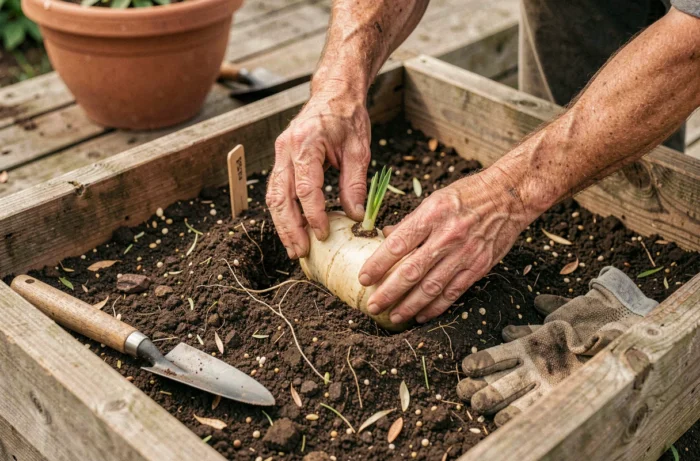
- Place a drainage layer at the bottom of the pot (clay balls or gravel), then add your soil-perlite mix up to halfway.
- Lay the rhizome flat, slightly flush with the surface. Do not bury it deeply, it needs light at its base to start well.
- Fill in with substrate, gently pack it down, and water just once to moisten everything without soaking.
Planting in the ground in mild climates
In areas where winter temperatures remain positive, the walking iris can live in the garden year-round. Plant it in a semi-shaded location, sheltered from the prevailing wind. The soil should be light and well-drained. A slope, rock garden, or raised bed works well.
Avoid depressions where rainwater accumulates. If your soil is heavy, incorporate coarse sand or fine gravel to a good depth before planting.
Light and watering: finding the right balance
The walking iris prefers bright but indirect light. An east or west-facing windowsill is perfect. Direct southern sunlight in the height of summer can scorch the tips of the leaves, while a location that is too dark will prevent blooming.
Why does this choice of location matter so much? Because the blooming of the walking iris naturally occurs between late winter and early spring, provided the plant has received enough light in the preceding months. Without proper brightness, you will get beautiful fan-shaped foliage, but no flowers.
Regarding watering, the rule is simple: let the substrate dry on the surface between waterings. Insert a finger into the soil up to two centimeters. If it is still moist, wait. In winter, significantly reduce the frequency, as the plant enters a phase of relative dormancy.
Natural propagation: how the walking iris moves
This is the most fascinating feature of this plant. After flowering (which lasts only one day per flower), the flower stalk does not die immediately. A small seedling develops at its end. Under the weight of this seedling, the stalk gradually tilts towards the ground.
When the seedling touches moist substrate, it emits roots and becomes autonomous. The mother plant has literally “walked” a step to a new location. In pots, this mechanism creates an increasingly dense clump. In the ground, the walking iris slowly colonizes the space around it.
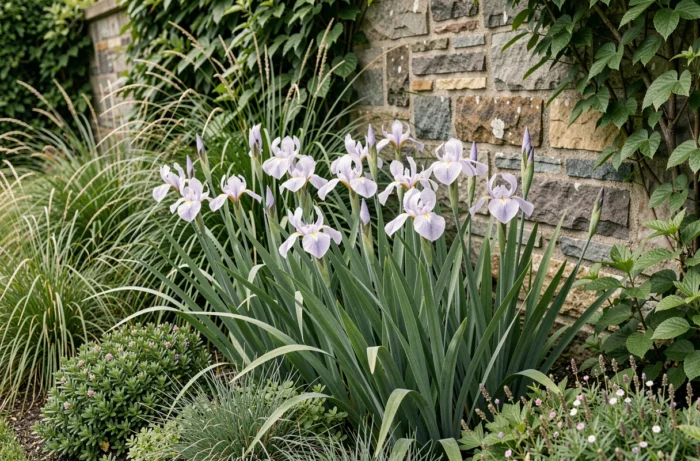
You can speed up the process by cutting the seedling once it has developed a few visible roots, then replanting it in an individual pot with the same draining substrate. This is a free and reliable multiplication method.
Good to know: the walking iris is not listed among invasive plants in North America. Recent inventories of invasive species, such as those from the University of New Hampshire Extension, do not mention it among the restricted plants. Its propagation remains manageable, especially in pot cultivation.
Common problems and seasonal maintenance
The walking iris is a robust plant, rarely affected by common pests. The two most frequent mistakes are overwatering (rhizome rot) and lack of light (absence of flowering).
- Yellow leaves at the base: check the drainage and reduce watering. Remove damaged leaves by hand.
- No flowering for over a year: move the plant closer to a bright light source. A summer stay outdoors, in partial shade, often triggers blooming.
- Foliage drooping: the pot may be too small. Repot in spring into a container just slightly wider than the previous one.
Aside from these adjustments, maintenance consists of removing dried flower stalks and providing diluted liquid fertilizer once a month in spring and summer. No need for pruning, no need for special plant treatments.
The walking iris is one of those plants that rewards patience more than intervention. A good substrate, proper light, and measured watering are enough to achieve spectacular blooms, even without prior gardening experience.