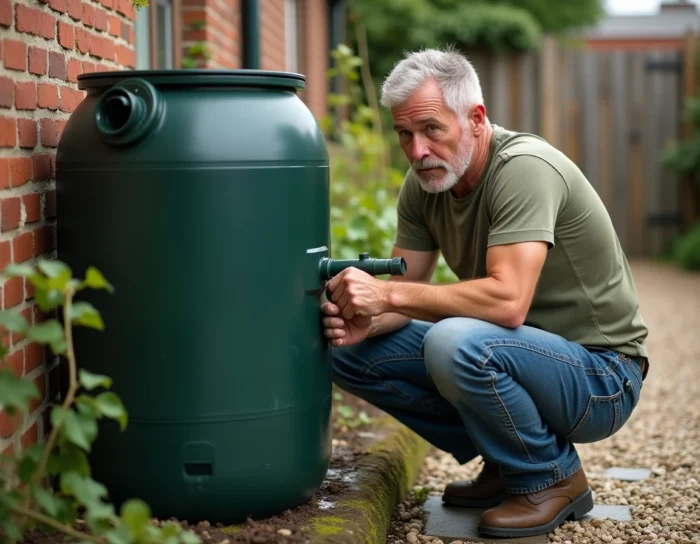
A rainwater collector installed under a downspout, properly connected, and yet the level remains stagnant. Before questioning the local rainfall, the problem almost always lies within the collection circuit itself: filter, connection, or tank. Identifying the blockage point allows for restoring the filling without replacing the entire system.
Quick diagnosis of an empty rainwater collector: control point table
When a collector remains desperately low despite rain, the logical reflex is to inspect the circuit from top to bottom, from the downspout to the withdrawal tap. The table below categorizes the areas to check in order of frequency.
| Control Point | Observable Symptom | Verification Time |
|---|---|---|
| Filter or gutter screen | Water overflowing from the gutter without reaching the collector | Less than 5 minutes |
| Gutter collector (connection) | Misaligned connection, missing seal, or connector blocked by debris | 5 to 10 minutes |
| Downspout to tank | Pipe bent, crushed, or clogged with decomposed leaves | 5 to 15 minutes |
| Improperly positioned overflow | Water drains through the overflow before the tank fills | Quick visual check |
| Leak at the bottom of the tank | Constantly wet ground around the reservoir | Perimeter inspection |
This sequential diagnosis avoids dismantling the entire tank for a problem that often lies at the gutter collector. When trying to understand why a rainwater collector that does not fill remains empty, the first identified cause is almost systematically a blockage upstream of the tank.

Blocked gutter collector: the cause that no one checks first
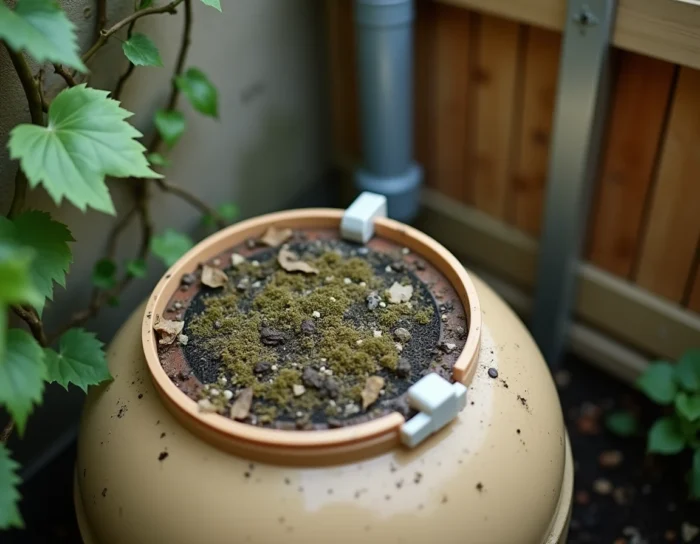
The filtering collector attached to the downspout is the most exposed link. Dead leaves, moss, roofing debris, and shingle sand accumulate over the months. A partially blocked collector allows enough water to pass through to give the impression that it is functioning, but the actual flow to the tank drops significantly.
Cleaning requires detaching the collector, removing the internal screen, and rinsing it with water. On cyclone filter models, a compact sludge deposit can form in the body of the collector. A pipe cleaner or bottle brush is sufficient to clear the passage.
Frequency of collector cleaning
In wooded areas or under deciduous trees, cleaning every two months between September and January maintains a correct flow. In open urban areas, two interventions per year (spring and fall) are usually sufficient. A clean collector restores filling without any part replacement.
Overflow and tank connection: when water enters but leaves immediately
A collector can receive water correctly and yet never rise in level. The problem then comes from the outlet, not the inlet.
- An overflow positioned too low relative to the usable volume of the tank drains water during the first rains. On some thin-walled models, the overflow connection is located at mid-height, limiting the actual capacity to half the advertised volume.
- A withdrawal tap that no longer closes completely (worn seal, loose handle) allows a constant trickle of water. The loss is slow but continuous, and the level drops between rain events without visible traces on the ground if the tap drips into a bucket or a hose.
- In buried installations or tanks connected to a pump, a faulty check valve can send water back to the stormwater system instead of storing it. The level rises during rain and then drops in the hours that follow.
Checking the overflow takes a few seconds: just look at what height it is perforated and ensure that the connection is not oriented towards the inside of the tank (a mounting defect that creates a siphon).
Network pressure and recovery pump: an underestimated factor
For rainwater recovery systems connected to a pump (automatic irrigation, toilet supply), the filling mechanism also depends on the available pressure. Since recent drought episodes, several municipalities have implemented nighttime pressure reductions on the water network, which indirectly affects mixed rainwater/city water systems equipped with automatic switching.
A poorly adjusted pressure switch on the pump can also prevent the system from detecting that the tank needs to be filled. The pressure switch interprets a residual pressure in the circuit as a full tank, and the pump does not activate despite a low tank level.
Chemicals and degradation of internal seals
The use of bleach tablets or concentrated anti-algae products directly in the tank weakens the seals of the withdrawal tap, collector, and overflow. Rubber membranes crack, and O-rings lose their elasticity. In just two seasons of use with excessive doses, the tap’s closing mechanism may no longer ensure tightness. Diluted white vinegar remains the only cleaning option compatible with elastomer parts.
Rainwater collector: seasonal recommissioning checklist
Rather than waiting for a filling problem to arise, a quick check at the start of the rainy season prevents the majority of failures.
- Detach and rinse the gutter collector, check for cracks on the filter body.
- Check the overflow level and ensure that the connection is oriented outward, not inward towards the tank.
- Open and then close the withdrawal tap to check for tightness. Replace the O-ring if a drop persists.
- In installations with a pump, purge the circuit and check the pressure switch setting.
- Visually inspect the tank for any cracks, deformation, or sludge deposits at the bottom (a muddy bottom reduces usable volume).
This inspection takes less than half an hour and covers almost all causes of non-filling. Replacing a tap seal or a filtering collector costs a few euros, whereas a tank overflowing from the gutter due to improper passage can cause facade infiltrations.
The rainwater collector remains a simple system, without electronics or complex mechanisms in most domestic installations. When the tank does not rise, the cause is almost always between the gutter and the tank inlet, over a segment of less than one meter. Starting there saves hours of unnecessary searching.