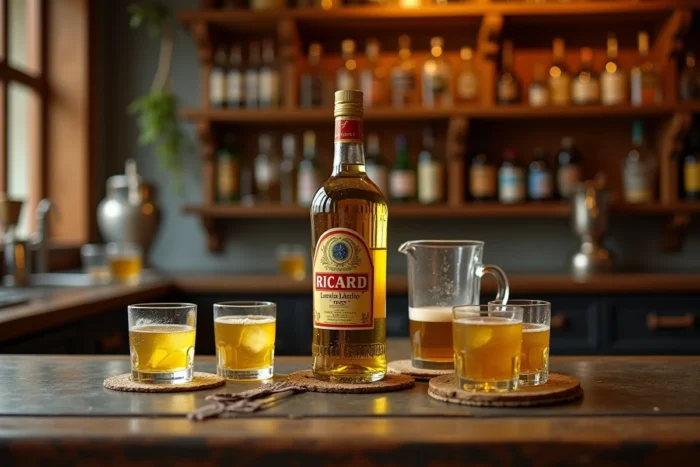
A standard bottle of Ricard contains 1 liter of pastis at 45% vol. Knowing how many glasses can be poured from it depends on a single variable: the volume of the serving. The professional reference in bars is set at 2 cl per serving, which results in a net yield of 50 servings per liter. At home, practices vary, and the actual number of glasses served can drop by half if the pour is generous.
The aim of this article is to provide exact calculations based on the bottle format and serving size, and then to examine why the standardization at 2 cl in establishments raises questions that go beyond simple glass counting.
Ricard Serving Table by Bottle Format and Volume Served
The calculation is based on a simple division: total volume of the bottle divided by the volume of a serving. Common formats in retail and CHR (cafés, hotels, restaurants) are not all identical, and the actual serving varies between a calibrated professional service and an aperitif among friends.
| Bottle Format | 2 cl Serving (bar) | 3 cl Serving (home aperitif) | 4 cl Serving (generous service) |
|---|---|---|---|
| 70 cl | 35 servings | 23 servings | 17 servings |
| 1 liter | 50 servings | 33 servings | 25 servings |
| 1.5 liters | 75 servings | 50 servings | 37 servings |
The difference between 2 cl and 4 cl may seem minimal in the glass, but it halves the number of servings per bottle. For an evening with 15 people where each has two pastis, you need to count 30 servings. With a 2 cl serving, one liter bottle is sufficient. With a 4 cl serving, you need two.
To know precisely how many servings are in a bottle of Ricard according to your own serving style, simply measure once the volume you actually pour, then divide the content of your bottle by that number.
Ricard Serving at Home: Why Theoretical Calculation Never Holds
In bars, a measuring spout or calibrated glass ensures that each serving corresponds to 2 cl. At home, no one pulls out a graduated measuring cup during the aperitif. The discrepancies are systematic.
Factors That Inflate the Actual Serving
- The diameter of the glass: a wide balloon glass gives the impression that the bottom is empty, prompting a larger pour. The same volume of pastis seems more generous in a narrow glass.
- The absence of a visual marker: without the 2 cl line marked on the base of the glass (like on the model designed by Mathieu Lehanneur for Ricard), the pouring is done by guesswork, and the observed average often exceeds 3 cl.
- The pace of the evening: the first servings are often measured, the subsequent ones less so. Over a long evening, the average serving increases over the hours.
A bottle of one liter advertised as 50 servings often ends up being between 25 and 30 glasses served in a home context. Planning for two bottles for ten guests with an extended aperitif remains a more realistic estimate than the theoretical calculation.
Standardization at 2 cl in Bars: Prevention, Taxation, and Establishment Responsibility
The 2 cl serving is not just a commercial practice. It lies at the intersection of several constraints that weigh on beverage operators.
Prevention and Public Health
Public Health France reminds us that no study defines a protective threshold for alcohol consumption and that the hypotheses of a favorable cardiovascular effect of low doses are widely questioned. In this context, the 2 cl serving serves as a minimal service benchmark, not a health guarantee. A bar that systematically serves 4 cl would double the pure alcohol intake per glass without the displayed price signaling it to the consumer.
Taxation and Stock Management in CHR
Aniseed spirits are subject to excise duties, calculated on the volume of pure alcohol. Each additional centiliter poured without being charged represents a direct loss for the establishment. With a calibrated serving of 2 cl, a one-liter bottle generates exactly 50 billable servings. Moving to 2.5 cl without adjusting the price results in a loss of 10 servings per bottle, or 20% of revenue on this item.
Stock management relies on this strict correspondence between volume purchased and number of servings sold. A discrepancy of a few milliliters per glass, multiplied by hundreds of monthly services, creates a measurable deficit during inventory.
Operator Responsibility
Managing a beverage outlet involves obligations of responsibility, especially during events. An operator who serves stronger doses than the professional reference exposes themselves to increased liability in the event of an alcohol-related incident. The calibrated measuring cup constitutes proof of due diligence in case of inspection or dispute.
Quick Estimation of Ricard Needed for an Evening
Rather than a single calculation, it is better to reason by evening profile. The number of bottles depends on three parameters: the number of guests, the average number of glasses per person, and the size of the serving.
| Number of Guests | Glasses per Person | Estimated Dose (3 cl) | 1 L Bottles Needed |
|---|---|---|---|
| 10 | 2 | 60 cl total | 1 |
| 15 | 2 | 90 cl total | 1 |
| 20 | 3 | 180 cl total | 2 |
| 30 | 2 | 180 cl total | 2 |
This table uses a 3 cl serving, closer to the home reality than the 2 cl professional standard. For a short aperitif (one hour), two glasses per person are generally sufficient. For a full evening, count three glasses per pastis lover and allowing a buffer volume of 20% remains prudent.
The standard ratio to remember: a one-liter bottle covers about 30 home glasses. Two bottles are sufficient for most evenings with up to 20 people, provided that pastis is not the only aperitif offered. Multiplying options (wine, beer, soft drinks) mechanically reduces the consumption of Ricard per guest and simplifies the calculation.