Checking the validity of your identity card is not just about looking at the date printed on the front. Depending on when the document was issued, the actual validity period may differ from what is stated on the card. This discrepancy leads to refusals at borders, administrative blockages, and confusion that official platforms struggle to clarify. This article measures the gaps between theoretical validity, legal validity, and actual acceptance according to different contexts.
Validity period of identity card: what the issue date changes
The validity period of a French national identity card (CNI) depends on two criteria: the age of the holder at the time of issuance and the date of issue of the document. The table below summarizes the different scenarios.
| Issuance period | Adult holder | Minor holder | Actual validity |
|---|---|---|---|
| Before January 2, 2004 | 10 years (stated on the card) | 10 years | 10 years, no extension |
| From January 2, 2004 to December 31, 2013 | 10 years (stated on the card) | 10 years | 15 years for adults (automatic extension of 5 years) |
| From January 1, 2014 | 15 years (stated on the card) | 10 years | In line with the printed date |
The most problematic case remains those cards issued between 2004 and 2013 to adults. The decree of December 18, 2013, extended their validity from 10 to 15 years without physically modifying the document. Therefore, the printed expiration date is incorrect: the card remains legally valid five years after this date.
For minors, no extension applies, regardless of the period. A card issued to a 12-year-old child indeed expires after 10 years.
A comprehensive guide dedicated to identity card verification on News Connect details the specific cases related to this automatic extension.

Expired identity card: accepted in France, often refused abroad
Under French law, an expired CNI can serve as proof of identity for many internal procedures (CAF, town hall, school registration) as long as the document remains legible and the photo allows for recognition of the holder. This principle stems from the very nature of the card: it attests to an identity, not a right to travel.
The situation changes as soon as it comes to crossing a border. Even within the Schengen Area, several countries refuse CNIs with an expired printed date, whether French extensions or not. Belgium, Norway, and certain German Länder have reported refusals at boarding or border control.
Traveling with an extended card: countries that pose problems
No exhaustive official list exists. The Ministry of Foreign Affairs recommends checking the country-specific information on the Travel Advice website for each destination. In practice, refusals tend to focus on cards where the printed expiration date is visibly exceeded, even if the card is legally valid in France.
- In France: a card expired for less than 5 years is generally accepted for routine administrative procedures, provided the photo is recognizable
- In the Schengen Area: acceptance varies from country to country, and sometimes from one control officer to another, with no guarantee
- Outside Europe: the identity card is not a recognized travel document; only the passport is valid
The most reliable recommendation remains to request renewal before any international travel, even if the card is theoretically extended.
Check the validity of an identity card online with France Identité
The France Identité application, developed by the State, allows users to create a digital identity from a CNI in bank card format (model issued since 2021). This digital identity offers a service for generating verifiable proofs for third parties via a secure QR code.
How the digital proof works
The holder generates an identity proof from the application. This document contains a QR code that any verifier can scan on the official France Identité portal. The system then confirms the authenticity of the proof and the validity of the associated title.
This mechanism addresses a specific need: allowing a third party (landlord, employer, administration) to verify the authenticity of an identity document without handling the physical document. The verifier only accesses the data that the holder has chosen to share.
- Creating a digital identity requires a CNI in the new format (biometric card post-2021) and a compatible NFC smartphone
- Certification of the digital identity can be done online or at the town hall, depending on the desired level of assurance
- The proof verification service is accessible for free on the France Identité website, without the need for an account for the verifier
Current limitations of the system
Only cards in the new format are compatible. Holders of an old plastic card or an extended card cannot use France Identité to generate a digital proof. Renewing the title remains the only way to access this service.
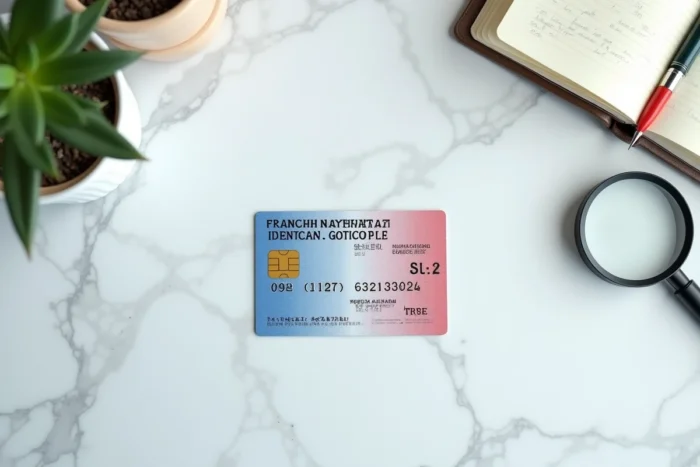
Visual inspection of an identity card: key elements
In the absence of digital tools, a visual inspection can help identify the most common anomalies. This type of verification does not replace a professional document check, but it is sufficient for everyday situations.
On the new format (post-2021), the card includes a contactless chip, a dynamic hologram, and a machine-readable zone (MRZ) at the bottom of the back. The consistency between the data in the MRZ and those printed on the front constitutes the first reliable check: name, first name, date of birth, and document number must match exactly.
On the old plastic format, security features are fewer. The photo must be clear, without signs of peeling or overlapping. The protective film should not have any bubbles or tears. Any visible alteration of the typography or background colors should raise an alert.
The printed expiration date, as we have seen, is not sufficient on its own to conclude the invalidity of the title. Cross-referencing the issuance date with the actual validity table remains the safest method to decide.
Early renewal of an identity card, even if still valid, is possible at the town hall by appointment via the ANTS platform. For holders of extended cards who travel regularly, this process avoids situations of blockage abroad and provides access to the digital services of France Identité.