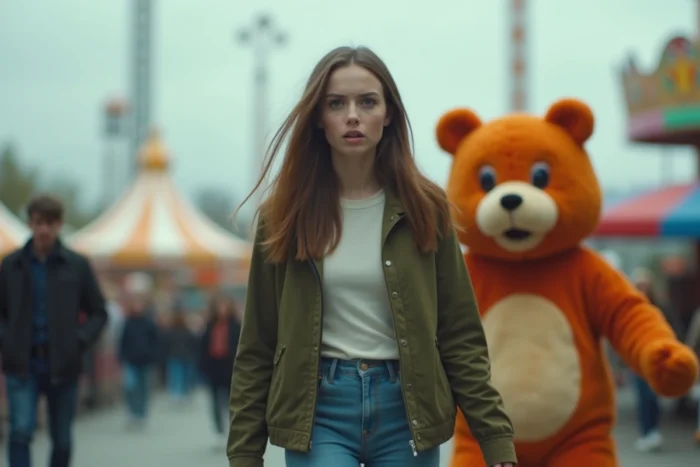
A child screaming at the sight of Mickey, an adult crossing the street upon seeing a fast-food mascot: the scene may seem trivial, but the distress felt is very real. The fear of mascots affects both children and adults, and its roots delve into brain mechanisms that neuroscience is beginning to illuminate. This often minimized disorder deserves closer attention.
Why a frozen face triggers fear of mascots
Have you ever noticed that a painted smile on a foam face can sometimes be more unsettling than a horror movie mask? The reason lies in how our brain processes faces.
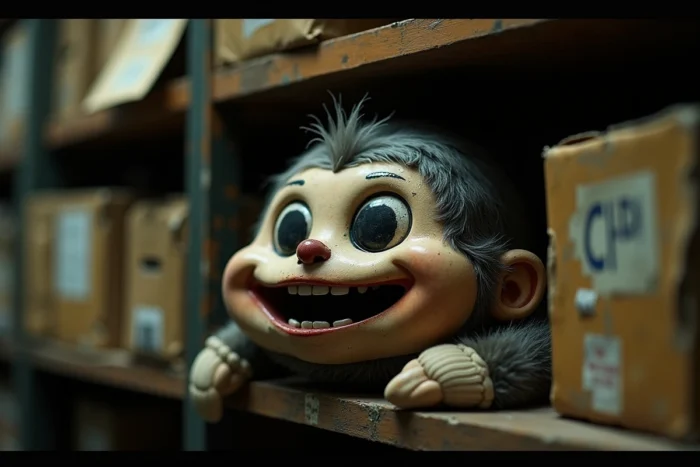
Under normal circumstances, we decode an interlocutor’s micro-expressions in a fraction of a second: furrowing of brows, squinting of eyes, movement of lips. These signals inform us about the intent of the person in front of us. A mascot eliminates all these cues at once. The face is frozen, the eyes do not blink, the mouth remains open in the same grimace.
The brain then receives a contradictory signal: the silhouette resembles a human, but the face does not behave like one. The amygdala, the brain area that evaluates threats, activates more strongly in response to these simplified or caricatured faces than to a neutral human face. This discrepancy between human form and the absence of readable facial signals is at the heart of the discomfort.
This phenomenon goes beyond mere mask fear. Child psychiatry clinicians emphasize that the inability to read the intent of the person inside the costume generates anxiety comparable to certain forms of social phobia. The issue is not the costume itself, but the invisible human it conceals. To understand the fear of mascots, one must therefore look at facial perception, not just the appearance of the character.
Childhood mascot phobia: a particular developmental ground
Not all children react the same way to a costumed character. Some run to throw themselves into the mascot’s arms, while others collapse in tears. The difference lies neither in courage nor in upbringing.
The sensitive period of facial recognition
Before the age of six or seven, a child’s facial recognition system is still under construction. The brain gradually learns to distinguish familiar faces from unfamiliar ones and then to interpret expressions. During this phase, a giant, motionless face constitutes an anomaly that the brain cannot categorize.
The child perceives a silhouette that moves like an adult, but whose face does not correspond to anything known. The result is an intense fear reaction, sometimes disproportionate to the situation.
The role of sensory context
Mascots rarely appear in a calm environment. Amusement parks, shopping malls, sporting events: noise, crowds, and lights add sensory overload that amplifies the reaction.
- The size of the character, often two to three times larger than a child, reinforces the perception of physical threat.
- Exaggerated movements (flailing arms, jerky gait) do not correspond to usual human gestures and disrupt the child’s motor references.
- The muffled sound or total absence of voice prevents any reassuring verbal communication.
These combined factors explain why the same mascot can terrify a child in a crowded park and only cause slight discomfort in a photo in a book.
Adult mascophobia: when fear persists
The fear of mascots is not reserved for children. In adults, it manifests differently: avoidance of places where costumed characters are present, panic reactions in professional or family situations (accompanying a child to a theme park, attending a game).
In the psychiatric classification of the DSM-5, this fear falls into the category of specific phobias, subtype “other.” It shares its territory with coulrophobia (fear of clowns), which explains why clinical literature rarely documents it as a distinct disorder. It is absorbed by broader categories, complicating access to appropriate care.
An adult who systematically avoids mascots adapts their daily life in sometimes burdensome ways. Refusing to accompany their children to certain events, leaving a store, taking a detour on the street: these avoidance behaviors reinforce the phobia instead of reducing it.
Approaches to reduce fear of costumed characters
The good news is that specific phobias are among the anxiety disorders most well-documented in terms of treatment. Gradual exposure remains the most commonly used method.
The principle is simple: gradually confront the person with the object of their fear, starting with the least anxiety-provoking stimuli.
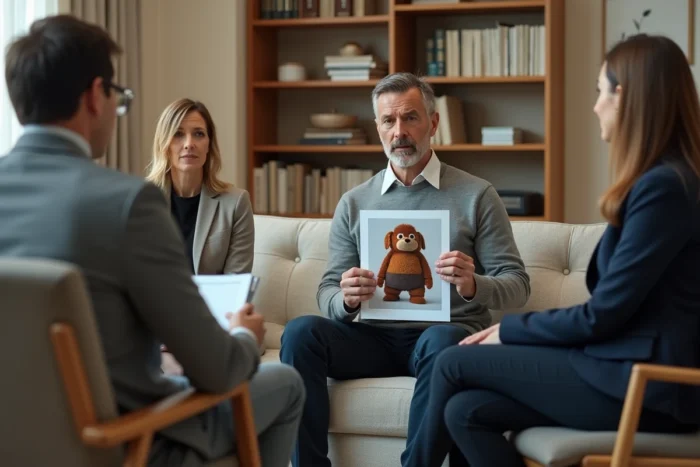
- Looking at photos of mascots in a calm environment, then videos with sound.
- Observing a mascot from a distance in a public place, without the obligation to approach.
- Gradually reducing the distance, maintaining control over the pace.
- Briefly interacting with the character, for example by waving from afar.
The key point is that the person maintains control over each step. Forcing a child to approach a mascot or ridiculing an adult for their fear produces the opposite effect: the panic reaction strengthens.
Some amusement park professionals have indeed adapted their practices. Costumed characters are instructed not to approach children suddenly and to step back as soon as any sign of distress appears.
The limits of the screen
Watching mascots in videos does not produce the same effect as encountering them in person. The actual size of the character, the lack of control over its movements, and the complete sensory dimension (smells, sounds, warmth) are missing on screen. Video desensitization prepares but does not replace real exposure.
The fear of mascots is based on a precise brain mechanism: the conflict between a human form and the absence of readable facial signals. It is neither a child’s whim nor an adult’s oddity, but a logical response of the threat detection system to an ambiguous stimulus. Recognizing this mechanism is the first step to addressing it appropriately, whether as a parent, event professional, or concerned individual.