
A clicking engine at cold start, a suspension that bottoms out on an poorly marked speed bump, a turbo that blows but the insurer ignores: we encounter these situations long before thinking about the word “tuning.” Optimizing a car’s performance and style starts with solving concrete problems, then seeking measurable gains without creating new administrative or mechanical headaches.
Single Vehicle Approval and Insurance: The Legal Framework Before Any Modification
We rarely start there, and that’s precisely the trap. In France, any modification affecting the technical characteristics of a vehicle’s approval may require a single vehicle approval (RTI) from the DREAL, followed by an update of the registration certificate. A car can pass the technical inspection while remaining non-compliant after a significant modification.
Engine remapping illustrates this ambiguity well. The technical inspection does not directly check the mapping, but it verifies emissions and faults transmitted by the OBD. If the actual power no longer corresponds to that listed on the registration document, the situation becomes irregular. And the insurer, in the event of a claim, may refuse compensation if the modification was not declared.
The removal or neutralization of the DPF, EGR, or SCR/AdBlue system is another regulatory point often overlooked in preparation guides. It is prohibited on a vehicle operating on public roads, subject to re-inspection and penalties. There is no benefit in starting a performance project by accumulating infractions that will cost more than the parts themselves.
To explore the catalog of tuning parts compatible with a legal approach, one can consult specialists like https://www.vegatuning.fr/ who offer components suitable for various models.
Engine Remapping: Real Gains and Technical Limits
Remapping remains the most requested modification because it promises a gain in power and torque without opening the hood. Stage 1, which focuses on optimizing the engine mapping without hardware modification, represents the entry point. We adjust the injection, boost pressure, and ignition timing to extract what the manufacturer has restricted.
Feedback varies on this point depending on the engine manufacturer and the starting vehicle. A recent turbo diesel or turbo gasoline engine generally offers a more exploitable margin than a naturally aspirated one. Moving to stage 2 already involves physical parts (intake, exhaust, intercooler), which increases cost and complexity.
What Remapping Really Changes in Daily Use
The gain is mainly felt in acceleration and flexibility at mid-range, not necessarily in top speed. On the highway, the difference is marginal. In the city and on the road, the additional torque makes overtaking more decisive and reduces the need to downshift.
The effect on reliability depends on the manufacturer’s original margin. An engine designed with a comfortable mechanical margin (reinforced block, oversized turbo) will handle better than a small three-cylinder already pushed to its limit. Not exceeding stage 1 on a fragile engine is often the most cost-effective decision in the long run.
Intake, Exhaust, and Cooling: Performance Parts That Change Behavior
When looking to go beyond mapping, three mechanical areas deserve priority attention.
- Air Intake: Replacing the original air filter with a high-performance sports filter improves the incoming airflow. On a turbo engine, coupling this modification with a larger intercooler lowers the temperature of the compressed air and stabilizes power on long journeys.
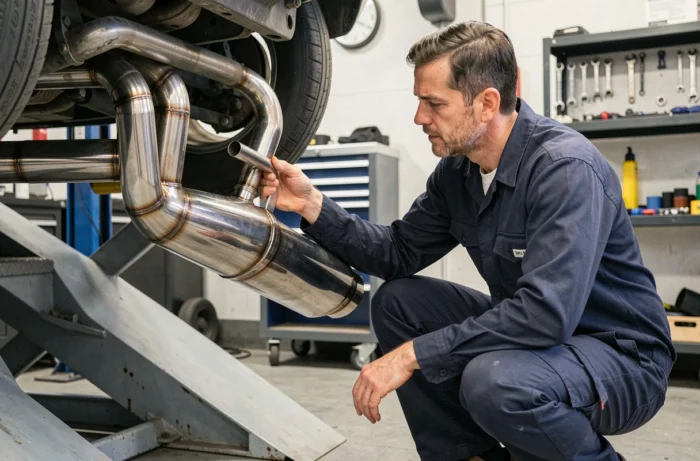
- Exhaust System: A sports exhaust with larger diameter headers and a less restrictive muffler allows gases to escape more quickly. The gain translates into better revving and, incidentally, a more pronounced sound. Care must be taken to stay within legal noise limits.
- Cooling System: An oversized water radiator or an oil kit with a dedicated radiator protects the engine during repeated stress. It’s a discreet investment that preserves reliability when other modifications increase thermal load.
These three areas work in synergy. Installing a sports exhaust without improving the intake creates an imbalance. The coherence of the installation matters more than the sum of the parts.

Car Style and Exterior Elements: What Changes the Look Without Compromising Homologation
Style is not just about stickers and neon lights. Well-chosen visual modifications also improve aerodynamic behavior or road holding.
Wheels, Tires, and Lowering
Upgrading to larger diameter wheels with low-profile tires radically changes the silhouette. Lateral grip improves, and the car appears more grounded. Combining this change with shorter springs or coilovers lowers the center of gravity and reduces body roll in corners.
A lowering of more than a few centimeters may require an RTI. Staying reasonable by aiming for moderate lowering, compatible with the original shock absorber travel and technical inspection constraints, is advisable.
Body Kits and Aerodynamic Elements
A front splitter, rear diffuser, or spoiler is not just for sports cars. On a production model, they channel airflow and reduce lift at high speeds. The choice of material (fiberglass, carbon, ABS) influences price and weight. Carbon remains the best rigidity-to-weight ratio, but costs can rise quickly.
For finishes (grilles, mirror caps, inserts), carbon or brushed aluminum parts provide a sporty look without structural modification. These elements do not pose homologation issues as long as they do not alter the overall dimensions of the vehicle.
E85 Conversion: The Economic Path That Requires an Approved Kit
Running on superethanol E85 significantly reduces the cost per kilometer. The regulatory path relies on a device belonging to an approved type, installed according to the conditions set by this approval. An unapproved kit constitutes a non-compliant modification and does not allow for the update of the registration document.
In terms of performance, E85 offers a higher octane rating than SP95, which allows for a more aggressive ignition advance on a remapped engine accordingly. The trade-off is a volumetric overconsumption, partially offset by the lower pump price.
Whether the goal is a power gain, a reduction in fuel budget, or simply a more assertive look, each modification impacts the vehicle’s reliability, insurance, and compliance. Checking the legal framework before ordering the first part remains the best way to enjoy your prepared car sustainably.