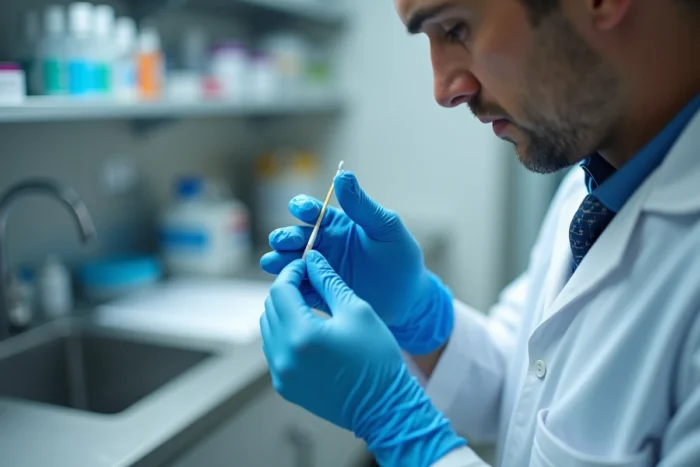
A roadside check, a saliva test, and the result comes in a few minutes. For cocaine, the window during which the substance remains detectable in saliva does not depend solely on the time elapsed since consumption. Metabolism, frequency of use, sensitivity of the device used: several parameters shift this window, sometimes significantly.
Benzoylecgonine and metabolites: what the saliva test is really looking for
The saliva test does not directly detect cocaine in its original form. It targets its metabolites, primarily benzoylecgonine, produced by the liver after ingestion. It is this molecule that persists in saliva while the stimulating effect has long since disappeared.
Why does this distinction matter? Because cocaine itself disappears from saliva within a few hours. Benzoylecgonine, on the other hand, remains measurable for much longer. A test calibrated for this metabolite therefore detects past consumption, not a present state of intoxication.
Most devices used during roadside checks or in companies set a detection threshold expressed in nanograms per milliliter (ng/ml). Below this threshold, the test shows a negative result, even if trace amounts remain.
An article detailing the issue of detectable cocaine in saliva for how long reminds us that this technical threshold creates a gap between the actual presence of the metabolite and what the test can measure.
Saliva detection duration for cocaine: occasional use and regular use
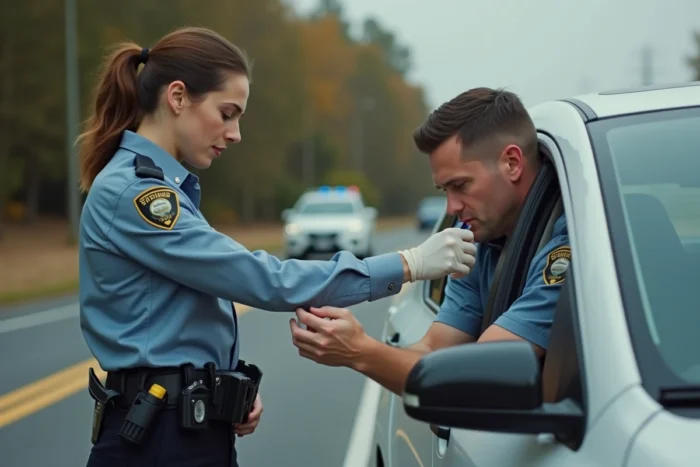
The duration for which a saliva test can detect cocaine varies according to the consumption profile. Two distinct scenarios emerge.
For occasional use, the detection window is about 24 hours. After this period, the concentration of metabolites falls below the test threshold, and the result turns negative.
For regular use, this window extends to one or two days, sometimes longer. The body accumulates metabolites, and their elimination takes more time. A person who consumes several times a week maintains a detectable level of benzoylecgonine in saliva longer than an occasional user.
These durations remain averages. Body weight, hydration, liver metabolism, and even saliva pH modify the elimination rate. Two people who consumed the same amount at the same time can yield different results 24 hours later.
Comparison with other screening matrices
Saliva offers a shorter detection window than urine or blood. In urine, benzoylecgonine remains detectable for several days with occasional use. In blood, cocaine and its metabolites are detectable less than 24 hours after ingestion.
- Saliva: about 24 hours (occasional use), one to two days (regular use)
- Blood: less than 24 hours, making it the matrix with the shortest window
- Urine: several days with occasional use, and up to several weeks with heavy use for certain drugs like cannabis
The saliva test therefore detects recent consumption. This is precisely what makes it relevant for roadside checks, where the goal is to identify use in the hours preceding driving.
Zero tolerance in France: why the legal threshold changes the game
Under French road law, the slightest trace of a narcotic in saliva is enough to constitute an offense. There is no legal threshold below which the presence of cocaine would be tolerated, unlike alcohol where a maximum authorized rate is set.
This zero tolerance has a direct consequence. A driver may no longer feel any effects of cocaine, have consumed the day before, and yet test positive during a check the next morning. The pharmacological window (duration of perceived effects) and the detection window do not coincide.
In practice, this means that the detection duration of the saliva test becomes the real legal limit. The body has eliminated the psychoactive effects, but not the metabolites. The driver is in violation.
Reliability and false positives: the technical limits of the saliva test
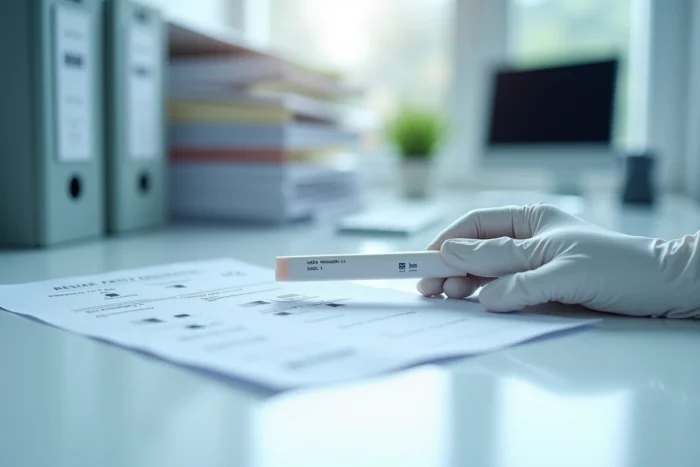
Have you ever heard of false positive results on a saliva test? This case exists, but it remains rare for cocaine. The immunochromatographic tests used in the field are designed to specifically react to benzoylecgonine.
However, a positive saliva test does not serve as definitive proof. It constitutes a preliminary screening. In the event of a positive result during a roadside check, a blood sample is taken for confirmation through laboratory analysis (gas chromatography coupled with mass spectrometry).
Several factors can skew the result:
- A very dry mouth or, conversely, excessive salivation alters the concentration of the sample
- The intake of certain medications can, in rare cases, cause a cross-reaction with the test reagent
- A poorly conducted sample (insufficient saliva quantity, contact of the swab with the lips only) decreases reliability
The right to a counter-expertise remains for anyone who tests positive. In professional settings as well as during a roadside check, requesting a confirmation analysis in a laboratory allows for clarification of a rapid screening result.
Saliva testing in the workplace: a distinct legal framework
Saliva testing in the workplace follows different rules from roadside checks. The employer can only impose a test if the internal regulations provide for it and if the position held presents a safety risk. The employee retains the ability to contest the result and request a medical counter-expertise.
The detection of cocaine in saliva during a workplace test raises the same question of the time window. An employee who consumed over the weekend may, depending on their metabolism and frequency of use, still test positive on Monday morning. The test does not distinguish between recreational use outside of work and consumption in the workplace.
The saliva test measures a chemical presence, not behavior. This technical limit remains the same regardless of the screening context, whether roadside or professional. For the consumer, the only certainty is that cocaine leaves a trace in saliva that far exceeds the duration of its perceived effects.